Code of Silence Part IV
How three decades of police corruption silenced seven unsolved murders in the California High Desert. Investigative Series.

The Town Sheriff Who Saw Bigfoot
By Mel Elorche
The late Lieutenant Ron Shreves of the Los Angeles Sheriff’s Department developed a theory regarding a continuing criminal enterprise linked to several high-profile unsolved murders in the Antelope Valley.
The multiple high-profile murders Shreves mentioned in his letter to his Assistant Sheriff, including those of, but not limited to, Los Angeles Sheriff’s Deputy Jonathan Aujay, Hollywood screenwriter Gary Devore, Lynn Standish, Michelle O’Keefe, Deputy Stephen Sorensen, Philip Privett, Majdy Haddad, Lyle Carter, and Rod Catsiff- continue to demand resolution supported by strong evidence.
According to Shreves’s list of connected murders and unsolved crimes, the National Guard Armory in Palmdale was robbed. However, the reports about a weapons heist at the Armory have vanished from the planet. There’s not one single news archive or police report on the robbery to be found. It was most likely suppressed and/or altered, or deleted, as was the case in some of the murder cases.

At the core of Shreves's theory, along with the research of retired colleagues who investigated these cases with the author, are several key individuals who may have contributed to the growth of this continuing criminal enterprise. Among the key individuals are: Deputy Rick Engels, Sergeant Joe Holmes, Deputy Dave Bower, Deputy Steve Gutierrez, Deputy Kerry Levenson, and Judge Steve Ogden.
In this part, a look at two individuals specifically:
One of the early suspects in the investigation of the missing and murdered Deputy Jon Aujay is Resident Deputy Rick Engels.
And then there is Sergeant Joseph Holmes, aka Joe Holmes, who was then an upcoming talent within the Sheriff's department. He had built a good reputation, despite his known affiliation with the deputy gang, the Vikings.
To this day, the former Deputy Rick Engels remains elusive, refusing to answer questions from both reporters and investigators. With his extensive network among suspected corrupt deputies in the Antelope Valley and strong connections to criminal networks, including those of Tom Hinkle, Del High, Dale Combs, and the Vagos motorcycle gang, Deputy Rick Engels has largely escaped scrutiny and punishment for alleged crimes. The two FBI agents involved in the investigation into the murder of Deputy Jon Aujay attempted to interview Rick Engels, but he refused to call them back. His own Sheriff’s agency's internal affairs unit, the Internal Criminal Investigations Bureau (ICIB), made Engels wait in a room for hours to be questioned about his purported ties to methamphetamine distribution. Engels did wait for the lead ICIB investigator to arrive, but he outright dismissed him and simply walked away.
Deputy Rick Engels was summoned to testify during the civil trial of Deputy Darren Hager, who famously won a whistleblower-retaliation suit against his employer, the Los Angeles Sheriff's Department. Detective Hager had worked along with Lieutenant Ron Shreves on the Silent Thunder task force and successfully arrested 300 individuals from six cells involved in the methamphetamine distribution in the Antelope Valley. The task force had also interviewed multiple informants who claimed that Deputy Rick Engels and criminal Tom Hinkle worked together and were involved in the murder of Deputy Jonathan Aujay, who was allegedly ‘killed at a meth lab’, ‘dumped in a well’, or ‘dumped in a hole or mine shaft’.
One of the task force’s early confidential informants (informant P or nr 5) came forward: word was out on the street that Deputy Jon Aujay was killed at a meth lab.
The informant P feared for his life if certain people found out that he was talking to the task force. He specifically mentioned that Deputies Gutierrez, Levenson, defense attorney Ed Consiglio, and Judge Steve Ogden mustn’t find out that he was providing information. Informant P also dropped a voicemail to the task force: ‘that Deputy Rick Engels was dirty.’
This informant got most of his information from Charlie Johnson, a transporter in the Tom Hinkle methamphetamine organization. Most informants didn’t even know the name Tom Hinkle; they only knew him by the name of ‘God’, as he decided who was killed and where people worked in specific labs. Known as a killer and Vagos associate, Tom Hinkle only managed his labs; he was very rarely there in person. This way, he could fear-monger and maintain control over his criminal domain.
According to the Narcotics Bureau, there was interest in finding out more about Judge Steve Ogden’s role or relationship with certain criminals.
Judge Steve Ogden was already the subject of a search warrant executed by the Narcotics Bureau. Paperwork was recovered from his home that included letters from ‘bad guys’ written to Judge Ogden that ‘showed more than a judge-bad guy relationship’.
The investigation was about a meth lab related to a kidnapping-rape case.
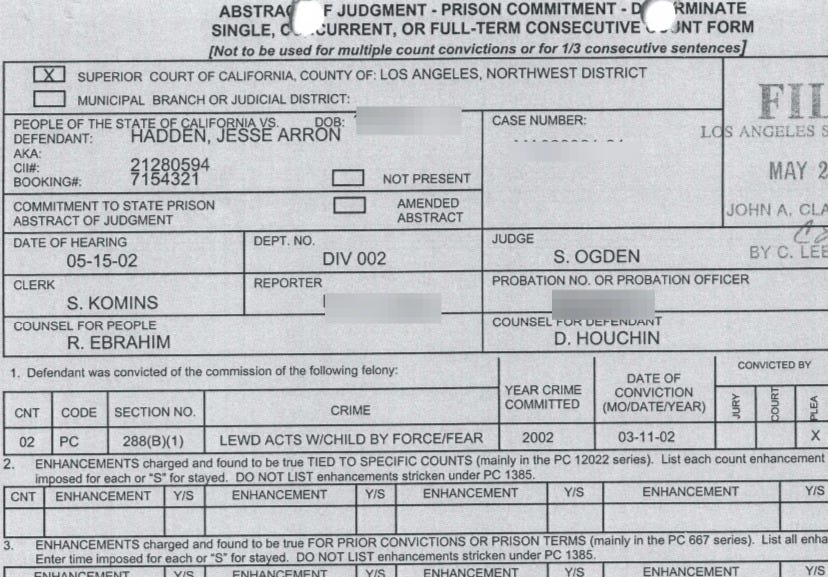
This could well be the kidnapping/rape case Judge Steve Ogden presided over, involving defendant Jesse Arron Hadden, who had kidnapped a minor and was sentenced to 8 years in state prison. Jesse Arron Hadden later told a fellow inmate that he knew who had killed Michelle O’Keefe, a student at Antelope Valley College, who was found shot to death in a parking lot in Palmdale on February 22, 2000.
The task force later learned that Judge Steve Ogden may have owned the property where the meth lab was, near Devil’s Punchbowl nature reserve, where Deputy Jon Aujay was allegedly killed, and later ‘dropped in a well’.
Another informant of the task force, nr 7 or Informant E., told investigators that he visited Tom Hinkle’s house to purchase drugs. Hinkle had asked him to wait in a backroom while he attended to a visitor. Informant E. continued that he had overheard a conversation between Tom Hinkle and Rick Engels. They were discussing the ‘lye provided by Tom Hinkle to get rid of something.’ Lye is a highly corrosive chemical and can be used to decompose bodies very fast.
Dumped in a hole - the many abandoned mines in California
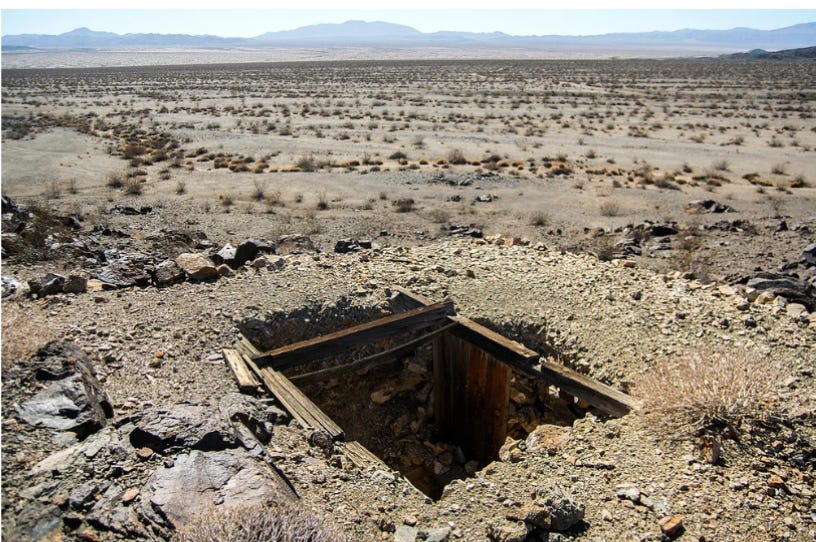
Shreves’s and Hager’s Silent Thunder task force was looking into areas where bodies could have been dumped or made disappear with or without the use of lye, a highly corrosive chemical that could be used to decompose bodies fast or poison people.
The Bureau of Land Management counts 47,000 abandoned mine sites in California, of which 31,490 are on Federal land.
Roughly 155 of them are in the Pearblossom, Littlerock, Acton, Wrightwood, Lake Los Angeles, and Llano area, including one near the site where Deputy Jon Aujay disappeared near Big Rock Creek: Empire Placer, a former gold mine, close to a property Judge Steve Ogden once owned.
The collection of evidence in a potential homicide by the Silent Task Force pissed Homicide Captain Frank Merriman off. In response, he yanked his Sergeant, Detective Larry Brandenburg, from a homicide investigation into the disappearance of Deputy Jonathan Aujay and expressed his frustration with the existence of the Silent Task Force. Larry Brandenburg and his detective partner, Weireter, were convinced about their number one suspect in the murder of Deputy Jon Aujay: Deputy Rick Engels.
Merriman was livid and quickly replaced Brandenburg with the hot talent boy, Sergeant Joe Holmes. Merriman was overheard saying: “You will take care of this for me, won’t you, Joe?”.
Subsequently, Sergeant Joe Holmes began to spread inflammatory accusations about Detective Deputy Darren Hager’s investigative work among fellow officers within the department. Holmes unleashed a smear campaign against the DEA/LASD task force, its leader, Kent Bailey, Lieutenant Ron Shreves, and specifically against Deputy Darren Hager.
Soon after, several deputies, including Deputy Rick Engels, turned against Deputy Darren Hager and filed complaints with the Ombudsman.- Engels even threatened to kill Hager. After an internal investigation and continued harassment by his fellow deputies, Hager was fired. He fought back and sued the LASD.
In the end, as indicated in Part I of this series, Deputy Darren Hager (then sworn in as a Marshall for the DEA) won this momentous whistleblower retaliation suit.
And then he saw Bigfoot
Deputy Rick Engels and Sergeant Joe Holmes were among the many department personnel summoned to testify during the Hager trial.
During several depositions in 2008 and 2011, Engels half-choked on his tobacco - “my bad habit” - and confirmed that he had seen Bigfoot at one point. What?
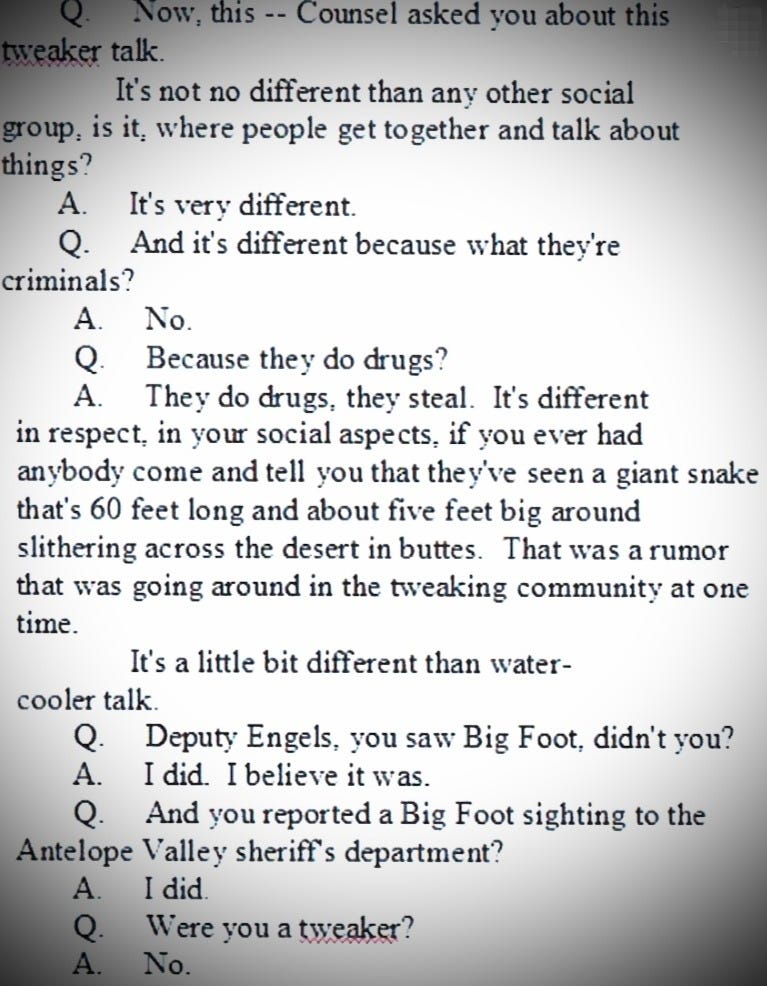
His words sent meth addicts (tweakers) and some of his fellow officers into a frenzy, laughing their eyeballs out.
Tweakers, who knew their Resident Deputy Rick Engels from up close, were now witnessing their 'kingpin' testify in a court of law. Was this guy going nuts?
The tweakers snickered maniacally, their giggles reverberating throughout the desert community. There he was on the stand, their supreme Resident Deputy Rick Engels, blabbing about how he had spotted Bigfoot, and on top of that, he testified that he had reported his Bigfoot sighting to his station (Lancaster). This was the one Resident Deputy who once held rein over their dope kingdom, making life in the Antelope Valley for meth addicts and distributors hell and heaven at the same time. And now they all watched him making a fool of himself.
After thoroughly examining the many high-profile murder cases, along with countless court documents, police reports, tape recordings, crime scene photos, and witness accounts, it’s likely that Rick Engels became the Town Sheriff at the the River Styx: dividing the lawful and corruptible, the living and the dead, washing evidence in the corrosive and silent waters of the underworld along the way.
Engels must have controlled over a large and wide continuing criminal enterprise in and around Littlerock, Lake Los Angeles, Pearblossom, Llano, and Wrightwood - deciding who could continue their drug distribution, warning certain criminals of upcoming search warrants (or not), withholding drug stash, taxing dope dealers, all with or without ‘casualties’ or ‘necessary killings of witnesses’. And he had some powerful allies standing with him and/or covering for him in the process.
Policing at the River Styx
Resident Deputy Richard August Engels was born on November 28th, 1957.
He studied Animal Science at Pierce College, enrolled in the Sheriff’s Academy in 1981, and was sworn in on August 24, 1984. He was stationed for his first assignment at the Men’s Central Jail. After patrol duty at Lancaster for a while with partner Deputy Don Self, Engels applied for the position of Resident Deputy.
In 1988, he became Resident Deputy of Littlerock, Lake Los Angeles, Pearblossom, Wrightwood, and Llano. He could work out of his house and only had to radio in his shift with the dispatcher, five days per week. He didn’t keep or was asked to keep or hand in paperwork of his shifts. He would handle calls, cruise around, and occasionally visit his station in Lancaster if he had a prisoner. From 2001, things changed, and his residency became under the supervision of the Palmdale station.
What attracted Rick Engels to being a Resident Deputy?
“I had the opportunity to show my ability to function on my own with minimal supervision.”
According to Engels, the advantage of having a Resident Deputy to the Department and to the community is:
“Because of the remoteness of the area, the Department saves a few hours each day in travel time getting a car from the station to the area. To the community, I live there. The people that I deal with are more or less my neighbors and working in the same area for a long period of time, and living in the same area, I get more involved in the community and knowing people, who's who in the zoo, if you will.”
And so he did become very involved in the Antelope Valley. He kept many notebooks on meth labs. At some point, he started his own business, Bear Track Guide Services, a hunting guide service operation. He advertised online and through the Safari Club, a club for hunters, according to Engels. He operated his hunting business in Angeles Forest, Kern County, and Kern River.
Engels contracted his Pierce College buddy, Lee Vorhies, a hustling carpenter on movie sets in Hollywood, to help him with this side business.
Years later, at Engels’ house, Lee Vorhies was found shot to death with his daughter, Jennifer Stoorasli. It was ruled a double suicide. The weapon used was a handgun belonging to Rick Engels. He explained that this woman, Jennifer Stoorasli, shot herself and that her father, upon finding his dead child, killed himself.
However, Homicide never followed through with an investigation.
It seems that Rick Engels enjoyed his freedom and independence as Resident Deputy. With no or little oversight or supervision, he could explain his ways at all times, and he could explain away anything untoward that had happened.
When Deputy Jonathan Aujay disappeared on June 11th, 1998, Deputy Rick Engels was not part of the search efforts. When Homicide detectives later questioned him, he claimed that it was his day off. Sergeant Joe Holmes was the one who pressed him to answer that it was his day off.
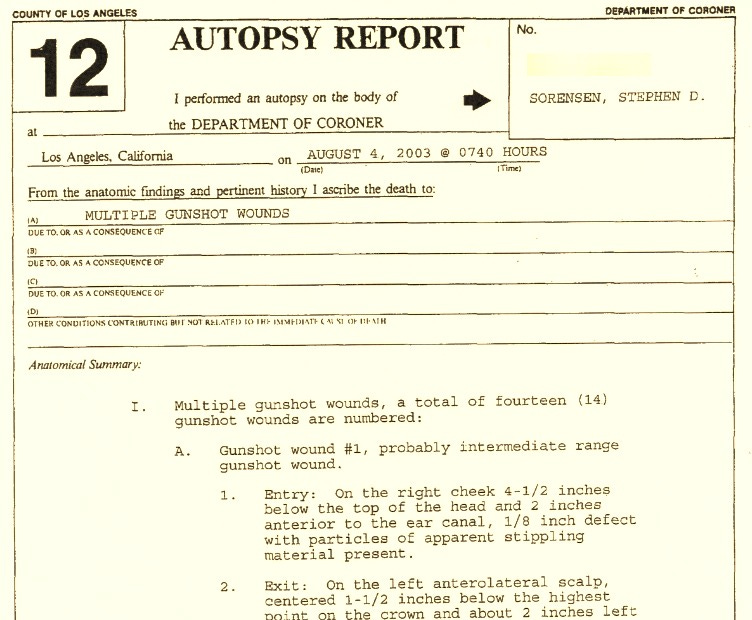
During the Hager trial, Deputy Engels was questioned multiple times in depositions about his schedule before and after the brutal murder of Resident Deputy Stephen Sorensen on August 2nd, 2003, and whether Engels knew the whereabouts of Sorensen’s missing notebook.
Resident Deputy Stephen Douglas Sorensen was found with fourteen gunshot wounds, and his brain had been removed. Read more about his murder in Part II of this series.
When investigations into the disappearance and murder of Deputy Jon Aujay kicked off, Engels was summoned by his Sheriff Commanders to sit down and wait for the Internal Criminal Investigations Bureau (ICIB) to show up: Engels would be questioned about allegations that he was involved in methamphetamine distribution. Well, that never happened.
When an ICIB sergeant wanted to ask Engels questions about cooking methamphetamines, Engels explained why he refused to answer questions from ICIB:
“I exercised my Fifth Amendment right not to say anything to him. I don't have to talk to him. I don't like him.”
Engels left the building.
Several retired detectives from the Los Angeles Sheriff’s Department have, to this day, sworn to find out what happened to Deputy Jon Aujay and who was responsible for the other high-profile murder cases in the Antelope Valley. One of the officers they interviewed was Deputy Randell Heberle. He confirms on tape that he always thought that Resident Deputy Engels was a ‘dirty deputy’.
Complaints arose regarding Rick Engels's grandstanding conduct as Resident Deputy. The owner of Cougar Ranch Inc., which operated an animal training business for the film industry, expressed concerns about Engels’ outrageous behavior. He can be heard on tape telling officers that Rick Engels fired automatic rifles across the street. This gunfire disturbed the animals on his ranch.
Sergeant Joe Holmes would later re-interview Deputy Rick Engels after Engels had become a main suspect in the Aujay disappearance. According to documents, Holmes would turn off the tape recorder mid-conversation. Why would he do that?
“Sometimes when you're interviewing people, they'll tell you a certain point, but they don't want to say it on tape. Sometimes you want to cut it off. They'll tell you because they will feel safe, then that nobody is going to hear it. But almost always when you turn the tape back on, they'll say it. Sometimes they do, sometimes they don't. It's an investigative tool. Sometimes they don't care. But my experience many times in investigations, especially homicides, a lot of times people will tell you things off tape they won't tell you on tape.”
Shaping Interviews and Polygraphs
It’s becoming clear that one of Deputy Engels’s allies was Sergeant Joe Holmes.
Holmes himself was also summoned to testify at Hager’s trial. When he was asked for his date of birth, Holmes played the court jester: “January 18th, 1949. I'm a young man.”
Holmes has had a long career working as a detective in the gang units of Firestone and Lynwood areas of Los Angeles. He trained at the Homicide School and quickly advanced to Sergeant in Homicide.
Holmes continued his deposition in the Hager trial by answering questions about the nature of his work. At times, he gave long-winded answers, showing off his bravura.
“Remember, whenever you go out on an officer-involved shooting, any investigation when it comes to a murder or an officer-involved shooting or a deputy-involved shooting, it is a criminal investigation. It's not an internal affairs investigation. It is a criminal investigation. What I'm saying is, in the midst of all my criminal investigations on these types of cases, I have never had a case where there was criminal culpability on an officer's part. Now, it has occurred over the years, but not with me.”
Before he was promoted to Sergeant, Deputy Holmes was a member of the Lynwood Vikings, one of the most notorious deputy gangs in the history of the Los Angeles Sheriff’s Department, responsible for racially motivated violence.
Joining a prestigious deputy gang like the Vikings meant that many deputies had to obey the code of silence and learn to shut up, even if they witnessed criminal activity by their fellow officers.
Suppressing Evidence and Tunnel Vision - the Lynn Standish murder
Even though it’s not been easy, to say the least, to collect hard evidence in the mentioned high-profile murder cases after almost thirty years, the murder of Lynn Standish seems to be one of the important keys to unlocking the truth about the other murders in the region.
Sergeant Joe Holmes and Resident Deputy Rick Engels go way back, and first worked together when they met at the crime scene of the murder of Lynn Standish in Pearblossom. Standish, a mother of two boys, had opened a microwave containing a pipe bomb.
Four-year-old Michael and his 9-year-old brother, Jeffrey, were hunting for recyclable cans and other materials in a desert dump with their mother, who had opened the microwave and was instantly killed. The boys suffered minor injuries.
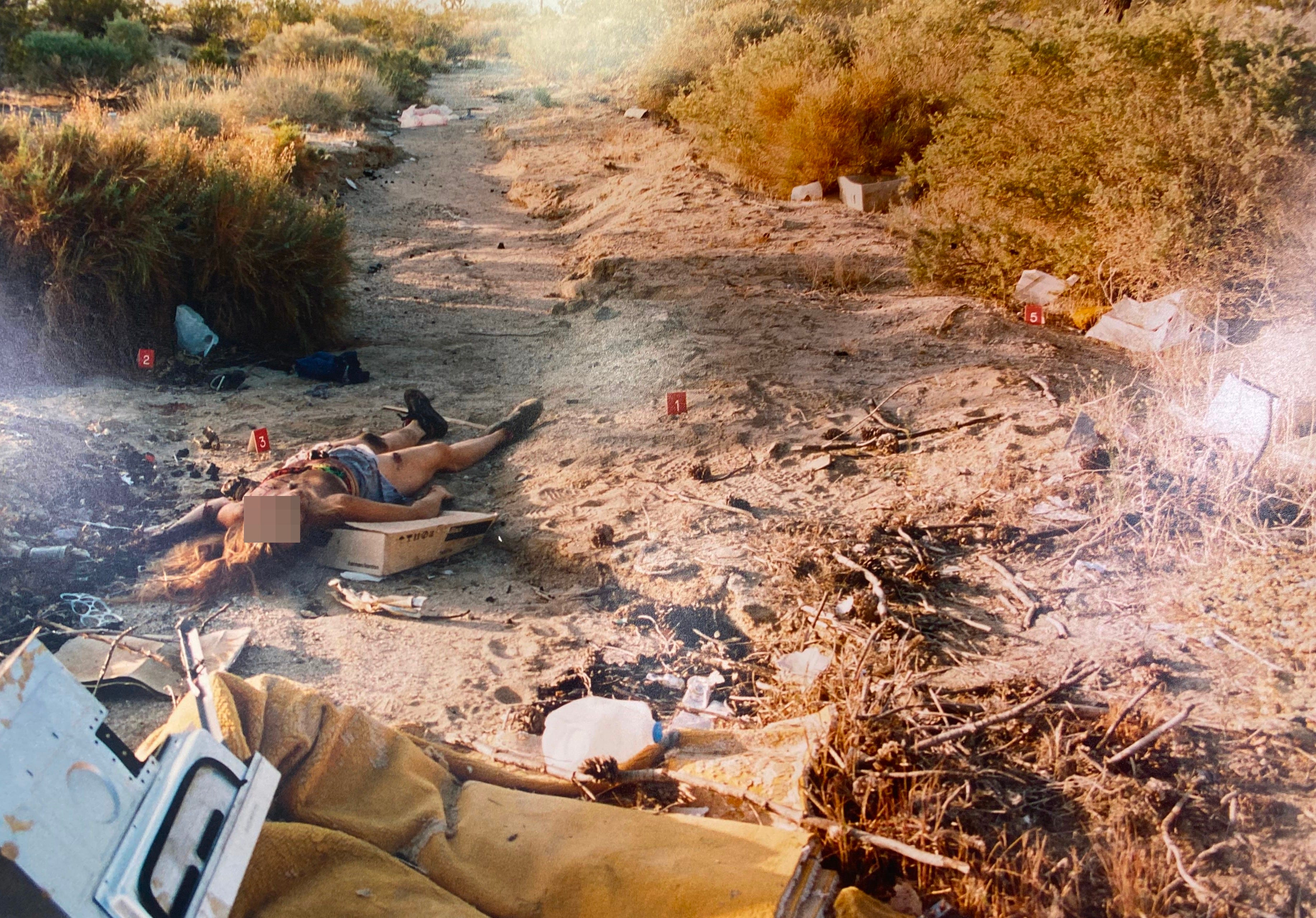
According to Sergeant Ron Spear, it was not immediately clear if the explosion was accidental or intentional.
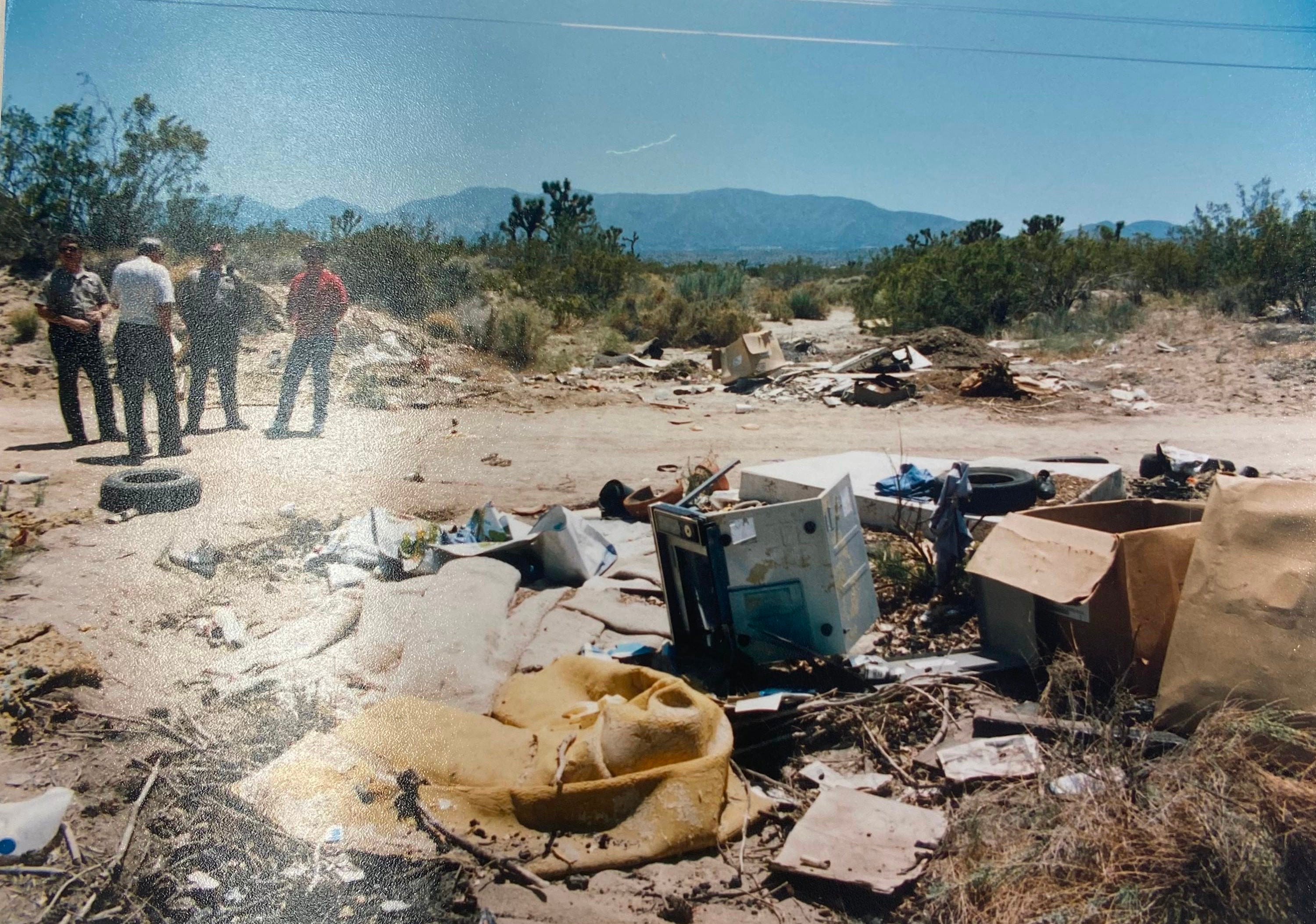
Resident Deputy Engels wrote the first report, as Sergeant Joe Holmes was assigned as the lead investigator. Tire tracks lead to the property of the notorious meth distributor Tom Hinkle, where a shed with bomb making materials was found.
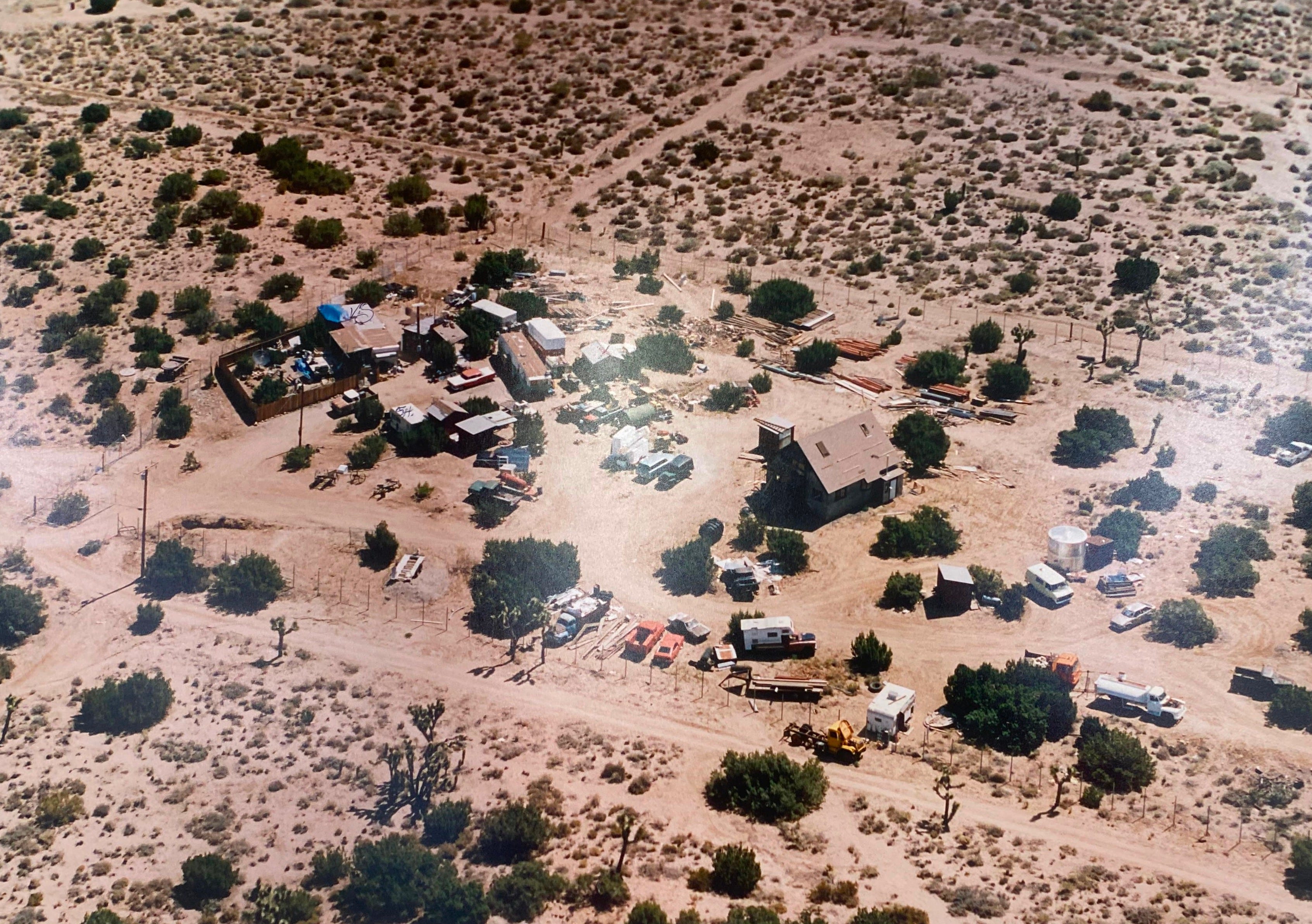


Holmes quickly determined that the bomb making materials belonged to the then-boyfriend of Lynn Standish, as he lived on Hinkle’s property. The boyfriend was the only prime suspect in Holmes’s book. The headstrong attitude of Sergeant Holmes in his investigation might be caused by ‘tunnel vision’: cognitive bias in the human brain, such as confirmation bias, that influences detectives to focus on a prime suspect, causing them to overlook evidence that points to other possible suspects. Or even worse, as in the case of the Lynn Standish murder, perhaps even downplaying or (deliberately) suppressing evidence that points to the real killer(s).
This confirmation bias also impacts families of murder victims, who, due to their trauma and grief, become convinced of their beliefs and expectations, and focus on one specific suspect, often ignoring or downplaying information that factually conflicts with that belief.
Two things stand out:
For one, Deputy Engels asked his fellow deputy, Darren Hager, to go up on a hill with a rifle, while Engels would enter the house of Tom Hinkle with a search warrant.
Secondly, Sergeant Joe Holmes quickly identified a main suspect: Lynn Standish's boyfriend. There was no other suspect in his book. He concluded that this suspect had created a bomb, placed it in a microwave for her to find in a pile of rubble out in the desert.
The suspect was eventually charged with the murder of Lynn Standish and still serves a life sentence in a California prison. Witnesses like Lyle Carter and a private investigator, Rod Catsiff, who investigated the case on behalf of the suspect, either were murdered or disappeared.
To this day, the framed suspect fights for his innocence. It is reasonable to believe that his confinement is unlawful because evidence was suppressed by investigators and prosecutors, who may have knowingly allowed false testimony at the trial.
Recently, the California Supreme Court issued an order to show cause returnable in the Superior Court of Los Angeles on all claims in his petition.
The Honorable Judge William C Ryan, who exonerated Raymond Lee Jennings in the murder of Michelle O’Keefe, is now deciding over his fate.

Overlapping investigations
When Deputy Jon Aujay’s disappearance became a homicide investigation, Sergeant Joe Holmes attended a meeting of the Silent Thunder Task Force and Homicide at the Federal Roybal building in Los Angeles. In front of DEA supervisors, Lieutenant Larry Lincoln, Lieutenant Ron Shreves, DEA agent Kent Baily, and Deputy Darren Hager, Sergeant Holmes matter-of-factly stated that he knew that Tom Hinkle and his wife were involved in the murder of Lynn Standish.
Shreves would later write in his memo: “Holmes volunteered that he knew Tom Hinkle very well and thought he would be able to interview him effectively.”
Holmes said, “Hinkle knows I know that he is involved.”
Holmes would later deny the statements he made. Eventually, Tom Hinkle was brought in for questioning regarding Deputy Aujay’s disappearance, and a polygraph test was conducted. Sergeant Holmes excitedly announced that Hinkle had passed the polygraph. However, the polygraph results were actually inconclusive.
When Sergeant Joe Holmes replaced Detective Larry Brandenburg in the homicide investigation of Deputy Jon Aujay, he seemed to have helped Engels by ‘shaping interviews’ during his investigation. He re-interviewed all persons of interest and informants that Brandenburg and his colleagues had interviewed. He documented these interviews based on his on/off tape-recorded sessions.
Sergeant Joe Holmes called Deputy Rick Engels. If they could meet at Devil’s Punchbowl, where Deputy Jon Aujay was last seen. Not in an interview room with witnesses, but actually in a park. Sergeant Holmes brought his partner, Deputy Brian Steinwand, to the meeting with Deputy Engels. According to Holmes, Engels was not working on the day Aujay disappeared, which was on June 11th, 1998.
He pressed Rick Engels to say exactly that during the interview.
Engels would later say during his video-taped deposition: “When I talked to -- when Joe Holmes talked to me at the Devil's Punchbowl after the investigation, he made me aware that my phone had been tapped. He told me about a situation where he had found out that these people who were saying that I killed Aujay had caught them in lies. He didn’t tell me what lies”
“He told me -- when he asked me what I was doing on June 11th, I told him I didn't know. I would have to pull my time sheets to see if I was working or not. And he told me that they already did that, and I was not working.”
Sergeant Joe Holmes never provided proof or paperwork of Engels’ time sheets.
The true killers of Lynn Standish are still alive and may come forward soon as witnesses, helping to uncover the truth.
A recent request to the FBI for the release of their investigative files on the murder of Deputy Jon Aujay led to the author receiving over 400 pages in the coming months. The FBI documents could be crucial to the ongoing investigation into Aujay’s death and other unsolved murders, as well as support the late Lieutenant Ron Shreves's theory that multiple murders are connected to the same perpetrators, who are protected by a network of criminals and former law enforcement officers.
©2025 Mel Elorche