Code of Silence Part III - Michelle O’Keefe
How three decades of police corruption silenced seven unsolved murders in the California High Desert. Investigative Series.

Dial 187 for murder
By Mel Elorche
Michelle O’Keefe was a bright and loving 18-year-old student who was tragically gunned down in a parking lot in Palmdale in 2000. Her murder is one of the cases retired Lieutenant Ron Shreves of the Los Angeles Sheriff’s Department discussed with other retired detectives when he mentioned to superiors that high-profile murder cases in the Antelope Valley were likely connected. Shreves had written a letter to his boss, Assistant Sheriff Bobby Denham, and stressed the urgency to investigate a link between the murders and a continuing criminal enterprise.
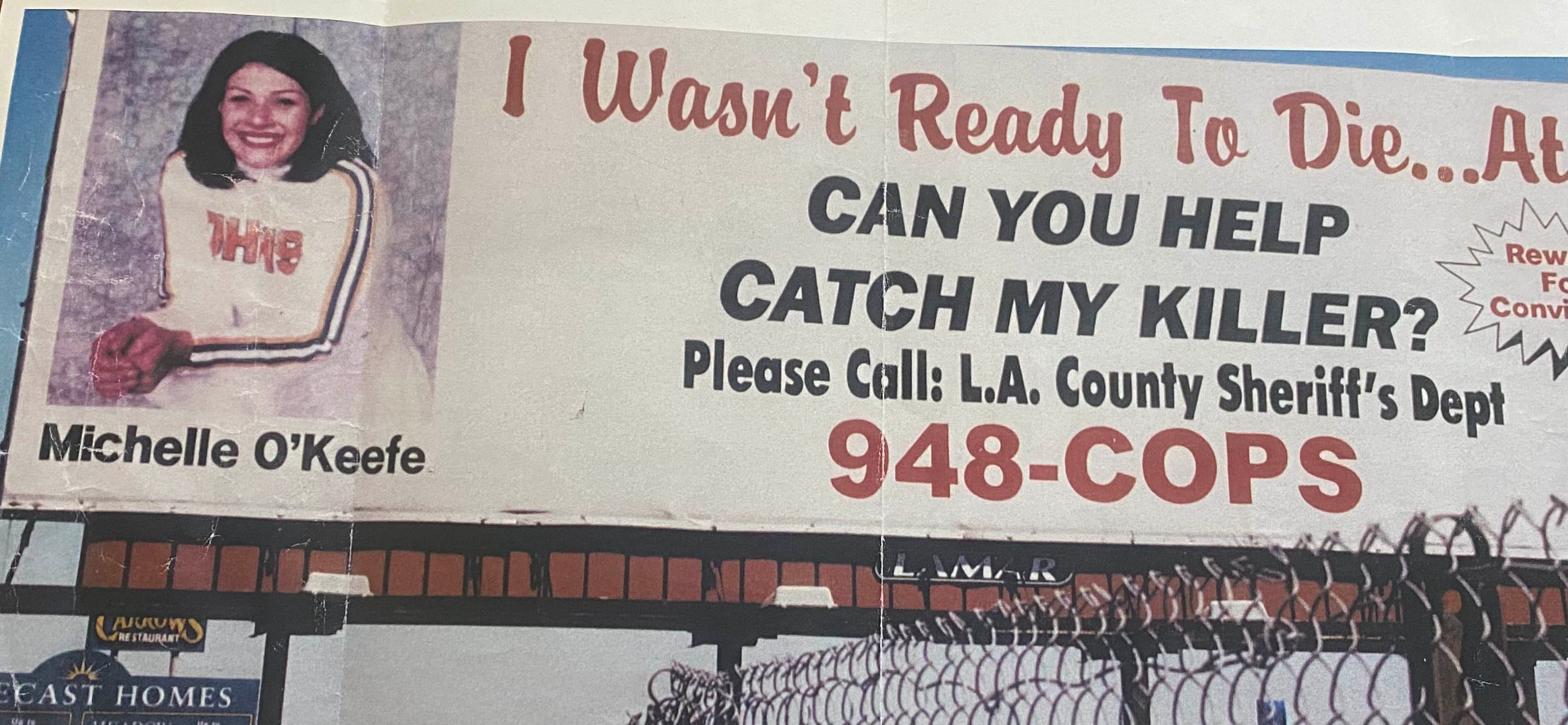
What happened to Michelle O’Keefe? - A public story
On February 22nd, 2000, Michelle O'Keefe was murdered in a Park-and-Ride lot at the intersection of Avenue S and State Route 14 in the City of Palmdale. A great deal has been spoken, written, broadcast, and speculated about that fateful night in February when the cheerful student Michelle drove home from a music video gig with her friend Jennifer Peterson. They headed to the Park-and-Ride in Palmdale, where Michelle had parked her brand-new Mustang. She would unlock her car and give her friend a snack bar as they said goodbye. Michelle was ready to change out of her performing clothes- Jennifer kept looking into her rearview mirror at Michelle as she drove away. It had started to rain slightly.
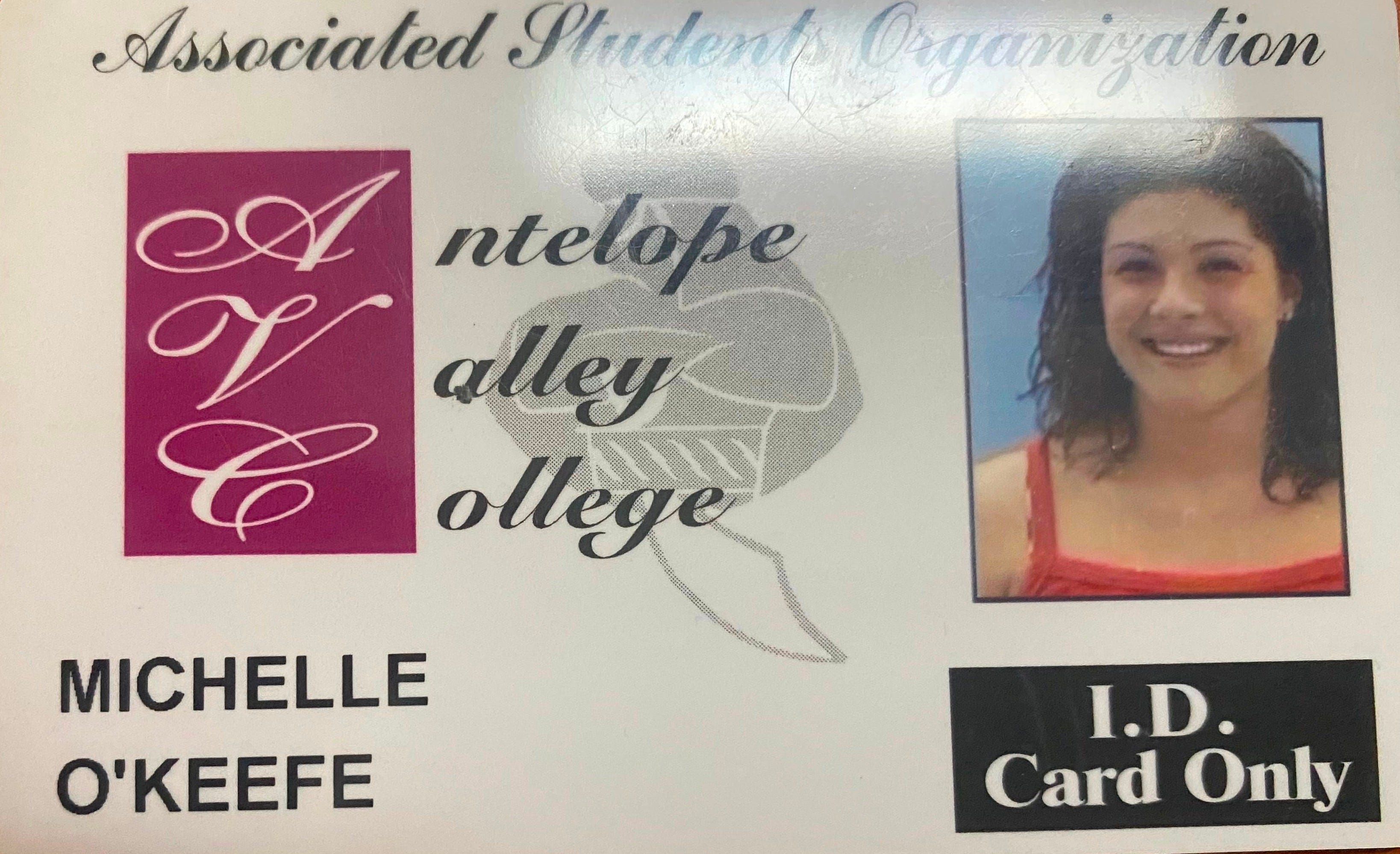
It was 9:32 pm when, suddenly, a car alarm blared through the mostly empty parking lot, followed by the sound of a gunshot.
One of the two security guards on duty on the east side of State Route 14 that night, Raymond Lee Jennings, ducked behind his car. He heard five more shots. He was trying to see what was going on. He radioed his supervisor. As a military veteran, Raymond had just started his new job at All Valley, the security company.
It is unclear where the other security guard, Glenn Lucas, was at that exact moment. It is alleged that he patrolled the other side, at the west side of State Route 14.


Raymond’s supervisor, Iris Malone, showed up ten minutes later. Raymond directed his supervisor to Michelle’s Mustang, which had rolled backwards and had come to a halt with its rear wheels in a planter. The supervisor asked Raymond to accompany her, but he refused. She drove alone to Michelle’s Mustang and saw Michelle O’Keefe with her legs partially outside the open car door. She directed Raymond to call 911.
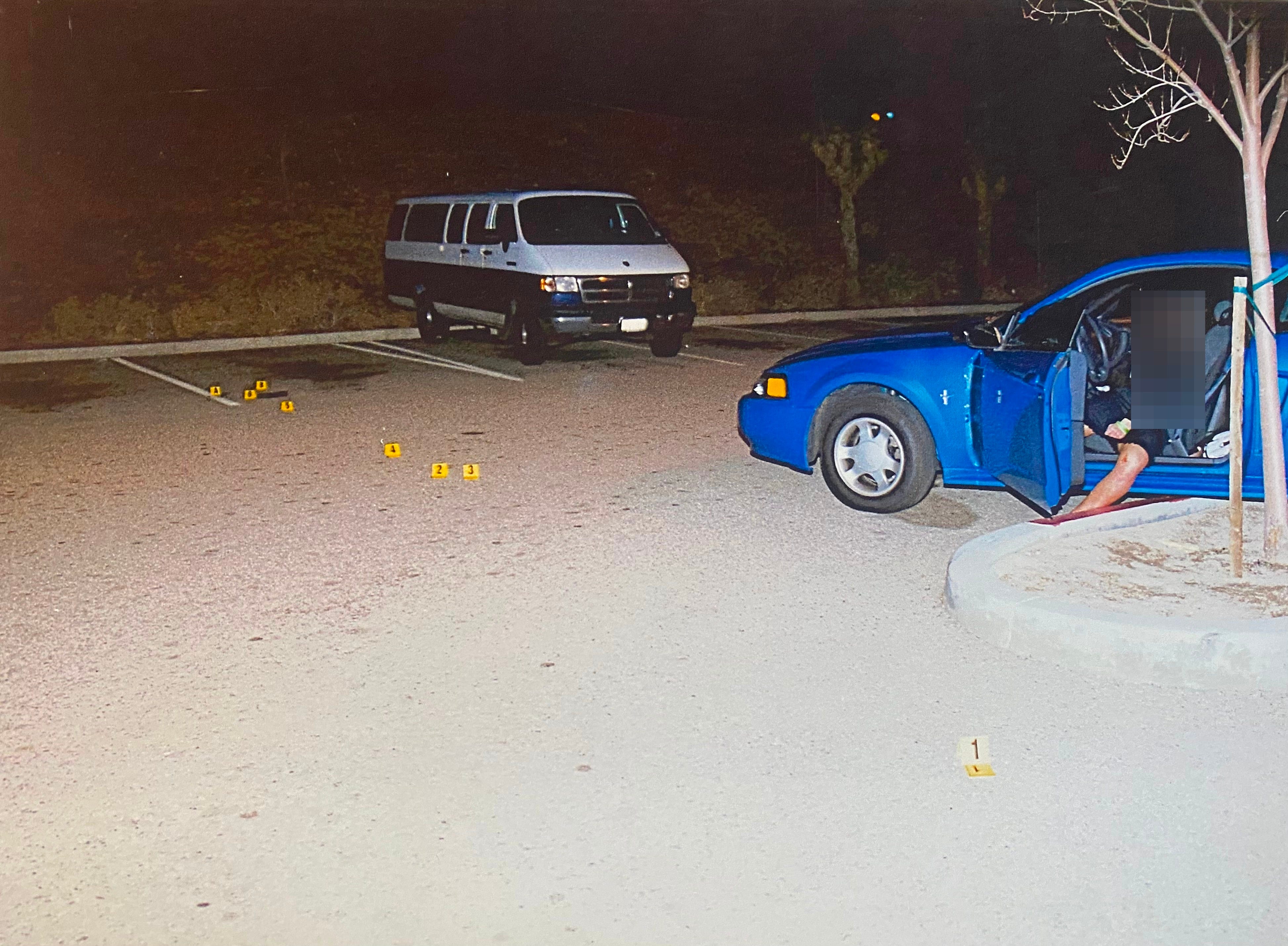
According to police reports and court transcripts, deputies of the Los Angeles Sheriff’s Department arrived in their unit cars at 9:37 PM. Deputy Billy Cox was said to be first on scene, together with Deputy Jeff Curran.
Deputy Cox later testified at Jennings’s trial that: "I entered the crime scene parking lot near the security guard parking spaces where Iris Malone first encountered Raymond Jennings. Jennings had returned to that spot and was there to flag me down coming into the lot."
Cox further states that Jennings was talking ‘excited and fast’ that somebody was shot and sent Cox down to Iris Malone, who was waiting about 30 feet from the Mustang, alone.
Cox declared on the stand that he took immediate steps to begin preserving the crime scene. Michelle's Mustang was facing north. Cox parked about 10 feet away, illuminating the front passenger side of her car. Cox specifically remembered that her passenger door was closed when he arrived on scene. He could not remember if he or someone else opened the victim's passenger door and glove box.
Cox noticed the Mustang's engine was running, in neutral, and that the emergency brake was disengaged. O'Keefe had suffered multiple wounds, including blunt force trauma to her forehead and four gunshot wounds to her face and chest.
After almost three hours, long after the deputies had set up the perimeters and searched the scene, two detectives of the Homicide Bureau signed in: Sergeant Richard Longshore and Detective Diane Harris.
The detectives found O'Keefe's wallet in the Mustang, which contained credit cards and $111 in cash. They also discovered three expended projectiles and three shell casings on the ground between the parking spot where O'Keefe had moved the Mustang and the car's resting place in the planter.
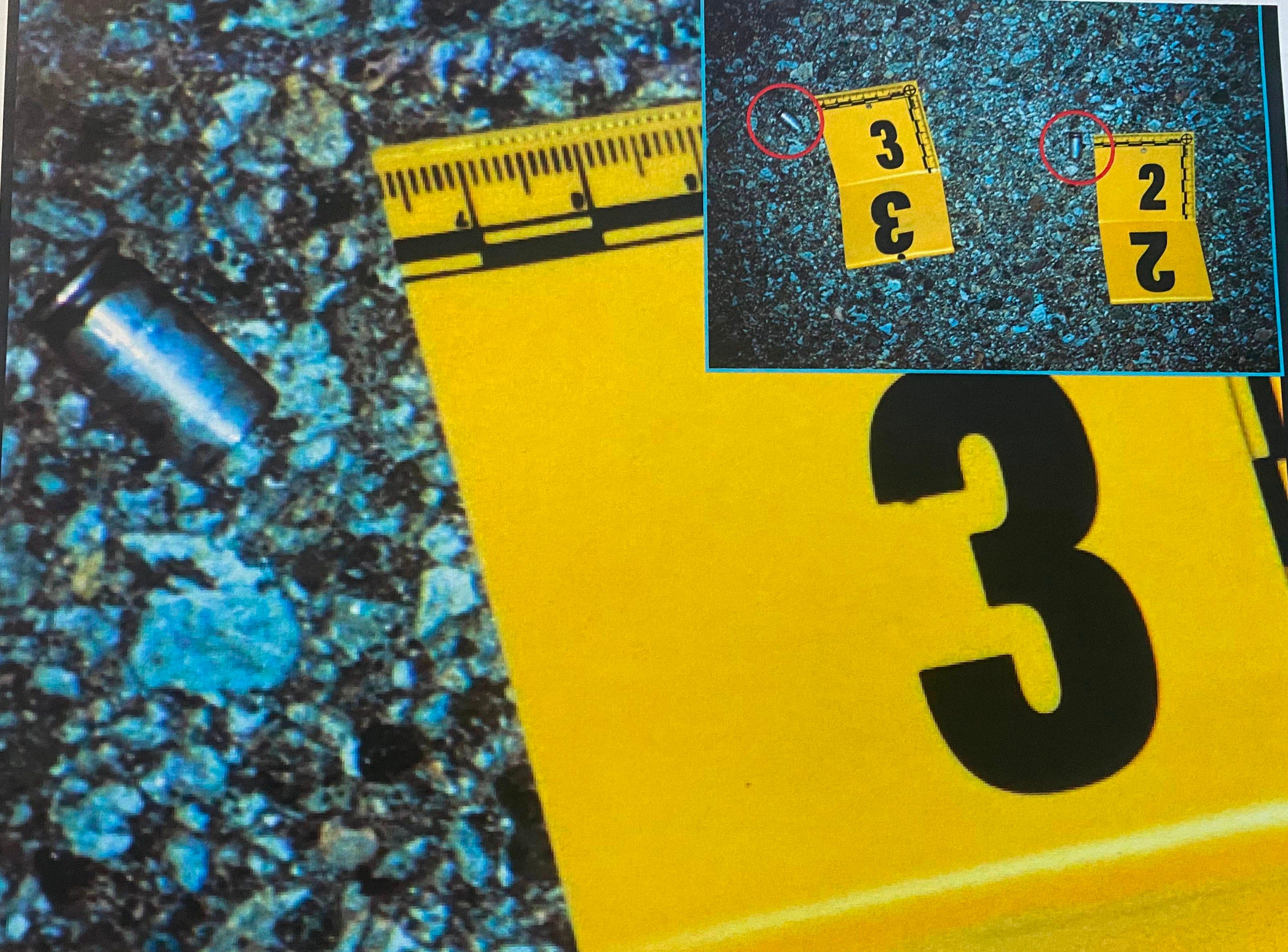
A firearms expert would later conclude that the projectiles and shell casings belonged to a nine-millimeter handgun.
A truck driver came forward and told Sergeant Longshore that he had spotted a gun on State Road 14. However, no weapon was ever found.
Sergeant Richard Longshore interviewed Raymond Lee Jennings and his supervisor, Iris Malone. Raymond told the detectives that he had been patrolling the parking lot on foot when he heard a car alarm and a single gunshot. He heard five more gunshots, but he never saw the shooter. He had stayed by his car because he didn’t know if the shooter was still out there. Somehow, word got out that Raymond Lee Jennings had seen someone running ‘up the hill'. A statement he has denied.
It’s unclear if Sergeant Richard Longshore and Detective Diane Harris also took statements from the second security guard, Glenn Lucas.
A witness, Victoria Richardson, would testify later that at the time of the shooting, she and three other people were sitting in a parked car near the northwest corner of the parking lot. The group was smoking marijuana and listening to music. Richardson stated that she heard a car alarm go off and then heard multiple “popping” noises. A few minutes later, Richardson supposedly saw a security car drive by. It was then that she and her companions decided to leave the parking lot.
As she drove away, they came across Raymond Jennings and asked him what had happened. According to the witness, Raymond answered that he did not know.
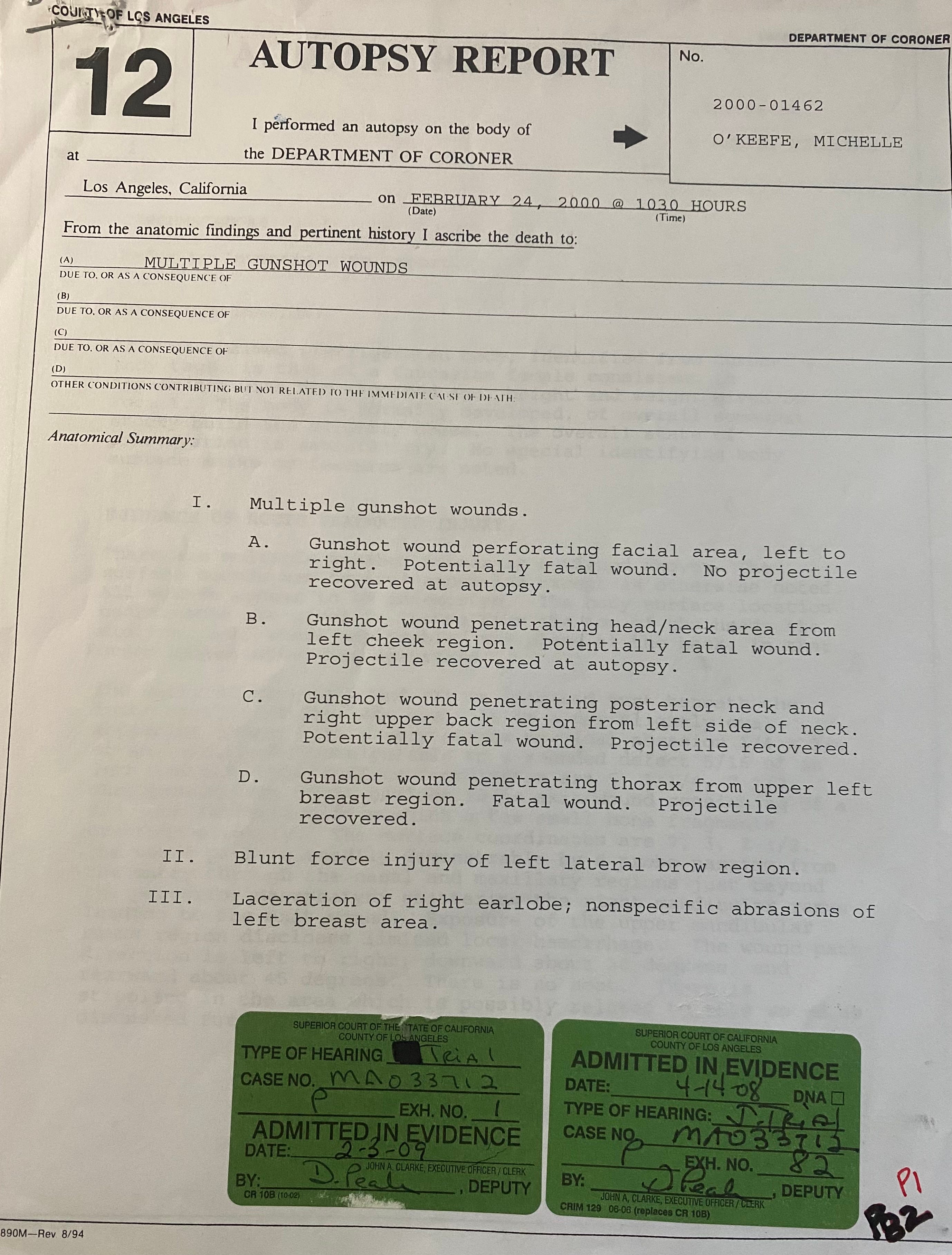
Michelle’s body was transported to the Los Angeles Medical Examiner’s office, where Deputy Medical Examiner Stephen Scholtz examined the state of Michelle’s body, the gunshot wounds, and the supposed trajectory of the four bullets.
Wrongful-Death
Raymond wasn’t immediately a suspect at that time. He quit his job as a security guard three days after Michelle’s murder and went on a tour in Iraq.
In the meantime, the parents of Michelle O’Keefe, Patricia and Michael O’Keefe, found in attorney Rex Parris a driven candidate to file a civil wrongful-death lawsuit against the Security Company All Valley and Raymond Lee Jennings. They could not believe that the LASD had not charged Jennings with murder.
Counsel for All Valley and Raymond Lee Jennings, attorney Craig Barnes, would question the relationship between Rex Parris and the Los Angeles Sheriff’s Department. Craig Barnes sought to get Rex Parris disqualified as counsel for the O’Keefes.
He suspected Mr. Parris had sought information directly from Homicide personnel about Raymond Jennings and the status of their investigation.
Sergeant Longshore told attorney Barnes in court that he was willing to offer to the parties in the case a copy of the nine-hour tape recording of the interview with Mr. Jennings. Sergeant Longshore said the offer was prompted by a request from Rex Parris and his office. He also said that although he had never spoken with R. Rex Parris, he could not guarantee that his deputies did not talk to him.
“Attorney Rex Parris has resided in the Antelope Valley for a long time and is well known by many of the Sheriff's deputies.”
Sergeant Longshore said he told his deputies not to discuss the case, but stated that he has no way to prevent that from happening. He acknowledged that the Sheriff's deputies may have shared information with Mr. Parris about the case. He could not explain how Mr. Parris was able to comment on the substance of Mr. Jennings’ statements to the Sheriff’s Department or the results of a polygraph examination.
As the wrongful-death civil lawsuit continued, upon his return from a tour of duty in 2005, Raymond was eventually brought in for questioning and charged.
Sergeant Richard Longshore, Detectives Sam Angulo and Diane Harris prepared the cognitive interviews with Jennings. Sergeant Longshore caught Raymond in a lie about his military service, and he had suspicions about Raymond’s movements in that parking lot that night.
Jennings was booked and jailed, awaiting a trial date. There ended up being three trials, two downtown in Los Angeles and the last one at the Antelope Valley Courthouse.
On December 18, 2010, Raymond Lee Jennings was sentenced to 40 years to life in state prison.
Raymond’s exoneration
Attorney Jeff Ehrlich and his son discovered the O’Keefe case and sought ways to write a Conviction Review Application for the newly established Conviction Review Unit at the Los Angeles District Attorney’s Office, which was under District Attorney Jackie Lacey at the time.
Ehrlich fought for Jennings’s innocence. There were never any eyewitnesses identifying Jennings as the shooter, nor were there any gunshot residue, blood, or fibers from O’Keefe’s clothing found on Jennings’ person, nor on his uniform. And the male DNA found under Michelle O’Keefe’s fingernail wasn’t Jennings’s DNA.


On March 17, 2000, Bart Weitzel, a reporter for the Antelope Valley Press, informed Lieutenant Ed Dvorak of the Sheriff's Department that the newspaper received an anonymous tip about the murder. Weitzel said a female called him earlier that day and said a retired private investigator, who feared for his safety, told her a gang member informed him that he was present when two other male gang members discussed the murder.
The LASD detective in charge of the investigation, Sergeant Richard Longshore, was dubious of the anonymous tip, stating that its assertions appeared to be far-fetched or improbable, based on the evidence at the scene and the totality of the investigation conducted to date. Both the LASD and the prosecutor, Michael Blake, had ruled out any potential gang involvement or the possibility of a robbery or a carjacking.
Retired FBI agent Peter Klismet, who was Jenning’s profiling expert during the trial, explained in his report submitted to the Conviction Review Unit ("CRU") of the District Attorney's Office, that the investigators honed in on Jennings.
“They developed the theory that Jennings was the killer, and then built a set of facts around Jennings rather than consider other, more viable suspects. It appears Jennings became the only suspect in their minds, and they made the facts fit that theory, while there were other options available. "
Mr. Ehrlich was successful in proving the innocence of Raymond Lee Jennings.
On January 23, 2017, Judge William Ryan recalled Raymond’s sentence of 40 years to life. The charges against Raymond Lee Jennings were dismissed.
To this day, the mother of Michelle O’Keefe, Patricia O’Keefe, is as convinced as her now ex-husband, Michael O’Keefe, that Jennings had killed their daughter. Their wrongful-death suit was dismissed in 2010. Patricia O’Keefe remains good friends with her ex-husband as she supports him in finding out what happened to their daughter. The family's loss has been profound, as they also lost Michelle's brother years later.
Patricia O’Keefe tells the author over the phone: ‘They never told us why Raymond was released. I had to Google what happened when his conviction was overturned.’
‘I told my ex-husband you had called me. Michael knows more about the case than I do. He loves to talk about it. Michael is totally convinced Raymond Lee Jennings did it. I believe it 100% that Jennings did it. Michael has about 15 things he can tell you why he thinks Jennings did it.’
187 for murder
Patricia talks about the premonition her daughter had about her own death. “Michael and Michelle were watching a movie about being killed. And Michelle didn’t want the 187 on her license plate. Because 187, she said, stands for murder.”
Before Michelle met her fate that February night in 2000, she had received the license plate for her brand-new Mustang. The plate had the numbers 187.
Raymond Lee Jennings is at a good place in his life, he says over the phone. When he was released from prison, he started a real estate business and later became an account manager at Coca-Cola. He enjoys taking care of his large family, which includes his children and grandchildren. “I don’t feel bitter about what happened. Life is good now.”
He tells how he experienced the night of Michelle’s murder and the ordeal he went through as a suspect. "It all went so fast; there were a lot of people around."
Does he feel he was set up? Raymond can’t answer that, but he does talk about who he thinks lied on the stand during the trials. “Deputy Billy Cox definitely lied.”
According to Raymond, Deputy Billy Cox lied about the fact that he saw Raymond on top of the hill. “Deputy Billy Cox lied when he said that when he came on the scene, he saw me standing on top of the hill flagging him down. And that he put me in his car, driving down. That is not true. I was standing below.”
Raymond expands on the testimonies of witnesses during his trial. He said that Michelle O’Keefe’s friend, Jennifer Peterson, had made inaccurate statements on the stand. According to Peterson, O'Keefe's car did not move, and she was always looking in her rearview mirror. And that she was changing her clothes before she went to class. Raymond questions that.
" Who is going to class at 9:30 pm?" What class is that?"
Apparently, Jennifer Peterson painted a totally different picture of Michelle O'Keefe as the good girl.
Raymond: “There was another friend who testified at my trial (this friend was most likely Melissa Cooper), who gave an opposite picture of Michelle as the partying girl who was in the dating scene.”
Michelle O’Keefe may have been dating after all, which contradicts statements from her family and friends who claimed she was not dating anyone and was still a virgin.
The relationship with Homicide Sergeant Richard Longshore was bad, Raymond says. “He came to my work, and at some point, I had had enough of being interrogated by Longshore, because I didn't kill that girl.”
At some point in his career, Deputy Billy Cox, who was reportedly first on scene, was terminated for falsifying police reports. When this information is shared with Raymond Jennings, he is taken by surprise.
“I discovered many things I was previously unaware of. Sergeant Longshore and Detective Harris had flown out to North Carolina and had interviewed my baby momma, Kalonia Jennings, and they were trying to find sexual misconduct. They asked her all sorts of questions about our sexual encounters.”
Raymond said that his wife wouldn't have it and 'really stood her ground'.
"I also learned that I was under surveillance the whole time. At some point, I drove to Edwards Air Force Base for my deployment to Iraq, and a car was tailing me all the way to the back entrance. When I entered the Airbase, the car turned around.”
Raymond says Detective Harris was demoted after his exoneration. “She was put into 'pedophile unit' or something (Family Crime Unit).”
As far as Raymond knows, there is no new investigation with leads. “It is publicly known that there is a suspect, a guy named Andrew, who may have killed her. It's one of the people who were in the car with witness Victoria Richardson.”
Again, does Raymond think he was set up?
“Why on earth was it possible that all of a sudden, there was evidence to arrest me in October of 2005, while in February of that same year, there wasn't enough evidence to charge me at all? When the Los Angeles Sheriff’s Department was ready to issue an arrest warrant back in February 2005, I was on tour in Iraq. It was found there was no evidence to charge me, and the arrest warrant was dropped.”
Jennings states that ultimately, the District Attorney Steve Cooley had to issue the arrest warrant because 'they owed’ attorney Rex Parris a favor.
“Rex Parris has a lot of power.”
Did District Attorney Steve Cooley owe Rex Parris a favor because Parris had previously helped 'make go away a DUI charge'?
Investigating hidden information
After numerous re-interviews and a thorough examination of hundreds of pages of court documents, exhibits, crime scene photos, and autopsy images, significant discrepancies appear between publicly stated facts and overlooked information.
FIRST ON SCENE
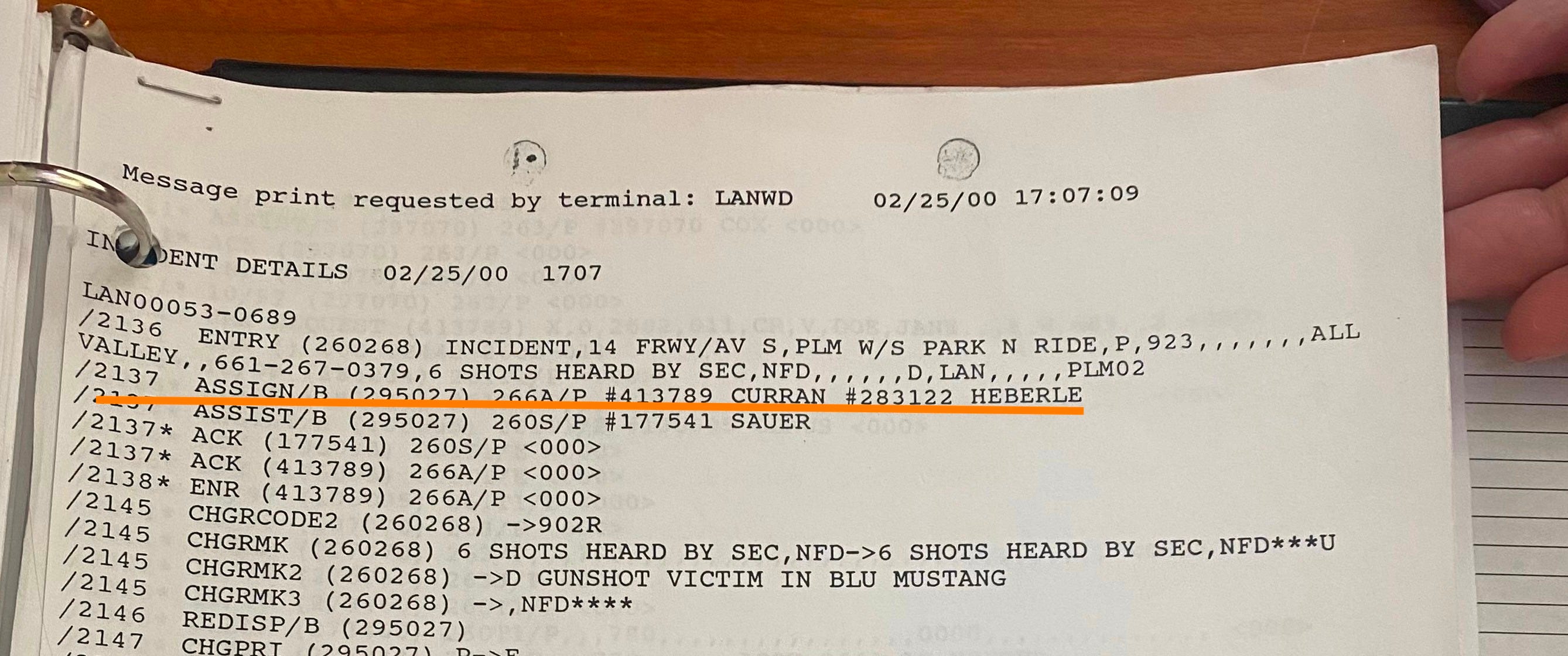
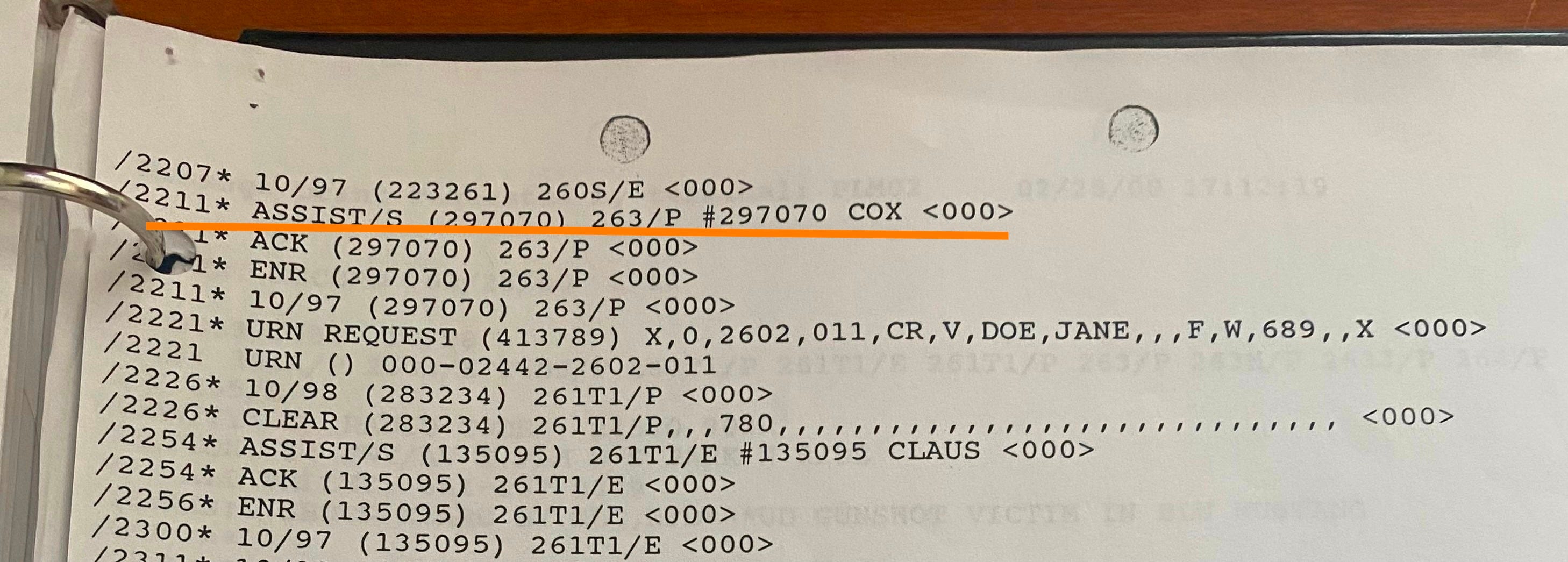
Deputy Cox was never first on scene, as was repeatedly reported in the news, in depositions, and even on the stand by himself. The prosecution and defense alike never mentioned the fact that Deputy Randell J Heberle was supposed to be first on scene with Deputy Jeff Curran, who also testified.
The arrival time of Deputy Billy Cox is indeed questionable. The radio log showed that Deputy Billy Cox was NOT the first Deputy on scene. It shows that Deputies Jeff Curran and Randell J Heberle were the first responding unit. According to the radio log, Deputy Billy Cox arrived more than 30 minutes later.
MOTEL 6 RECEIPT
What was largely known was that Michelle’s phone was missing from the scene. Only her phone wallet was found with cash. But was it ever investigated why Michelle had a motel receipt for a visit a month earlier? In examining all the exhibits, the author discovers a receipt signed by Michelle O’Keefe for a stay at Motel 6 in Big Bear in January 2000.
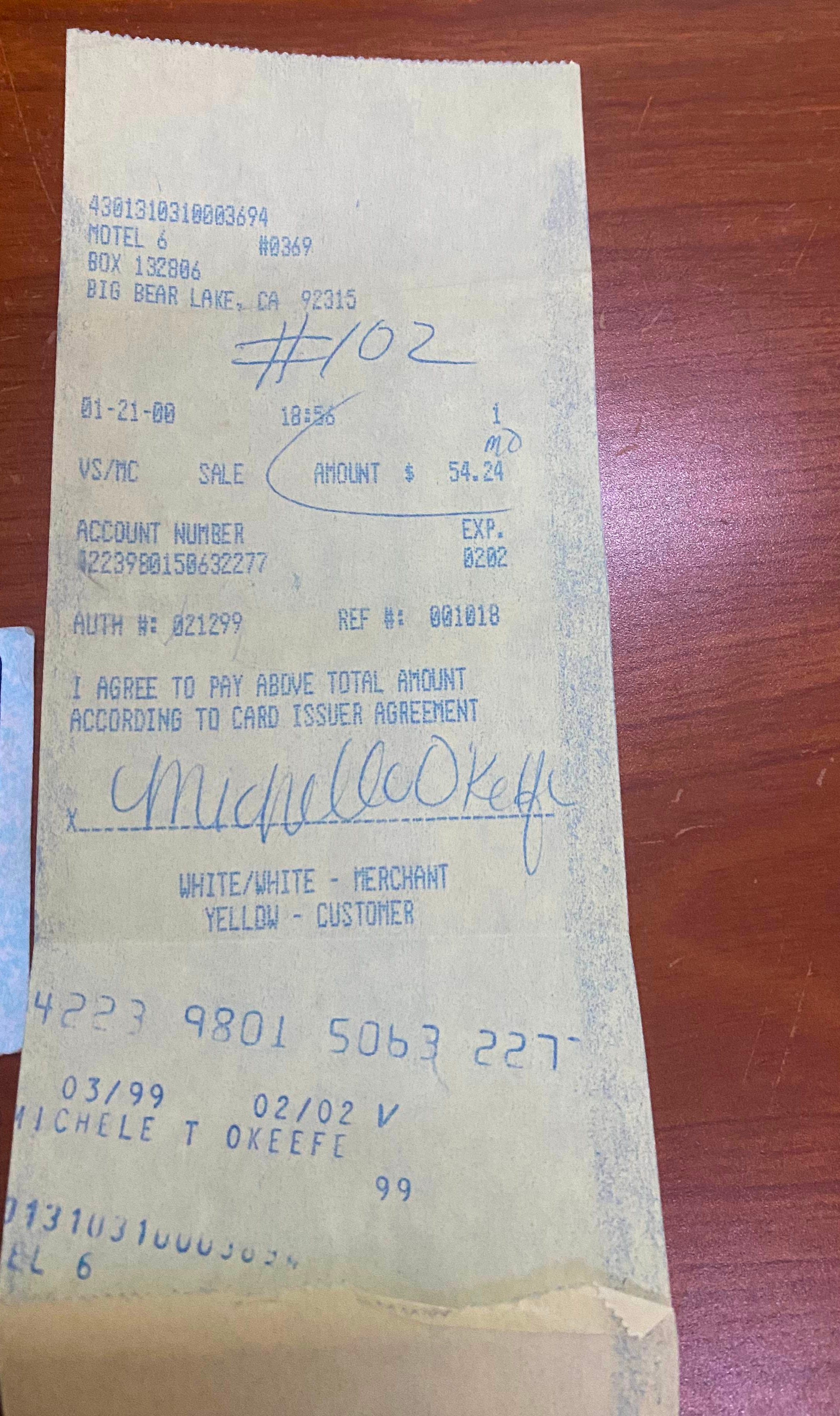
Why didn’t Detective team Richard Longshore and Diane Harris follow up on this receipt?
Motel 6 in Big Bear has not retained visitor records from over twenty years ago. It’s possible that Michelle’s stay was completely innocent. However, the question remains: Was she alone in room 102, or if she had company, who was with her?
SHERIFF’S SCOUT
Michelle O’Keefe’s girlfriend, Jennifer Peterson, was a scout at the Sheriff’s Department, and her mother worked for law enforcement.
The Los Angeles Sheriff’s Department places great importance on its scout program. Scouts accompany deputies while they perform desk duties, handle paperwork, and participate in public awareness events and volunteer work. Through this experience, scouts learn about police procedures, criminal law, and the importance of community service.
Did Michelle O’Keefe, unbeknownst to her family, indeed date/befriend a cop? Before her death, as per the memory of her father, Mike O’Keefe, Michelle told him that she didn’t want the license plate for her Mustang. The license plate read: 187, which is the police code for murder.
How did Michelle O’Keefe know that 187 is a code for murder? Perhaps through general knowledge or likely through her connections with Jennifer Peterson and law enforcement.
AND THEN A STRINGER CAME ALONG
Media stringer Frederick Hall (his real name cannot be disclosed for safety reasons) was at the peak of his career as a photographer and cameraman when he was called to the crime scene of Michelle O’Keefe. During the late 1990s and early 2000s, he was consistently among the first or second media professionals to arrive at crime scenes in the Antelope Valley.
Hall says in a phone interview that certain individuals contacted him to come to the Michelle O’Keefe crime scene. However, he has refused to disclose the names of the law enforcement officials who reached out to him.
During the conversation about the crime scene, he realizes that he was asked to be there early for a specific reason, which he didn’t realize at that time.
“They asked me to come early. I can’t tell you who ‘they’ are. When I arrived, I assisted deputies in taping off the scene. I was in Michelle’s car at some point, next to her body, taking photographs. It took a long time, several hours, for the detectives to arrive.”
According to the stringer, he has had good relations with a lot of deputies and sergeants.
THE RED TRUCK
After Michelle was killed at the Park-and-Ride, Raymond Lee Jennings returned to his job the night after. There was a lot of commotion, and the press was everywhere near and around the parking lot.
On the second night after the murder, Raymond Lee Jennings was doing his rounds when he was approached from behind by a red truck. Two white males started asking him ‘very specific’ questions. “They asked me questions like ‘Do you think he was hiding and waiting for her?’ and then they asked me: ‘Do you think he ran off down there? There is a field over there or some other. Do you think he ran that way?’
It was clear to Raymond that these guys were trying to find out what he had witnessed.
“And then they asked me, ‘Were you the security guard out there that night?’ I told them ‘no’.”
The two guys continued to ask Raymond: “Well, then, where is he at? Does he live around here?”
Raymond told them he didn’t know anything. “I told them he probably turned in his uniform and quit.”
Raymond felt threatened, as if one of them would shoot him. He could not see their hands. His intuition told him he was in danger.
The truck eventually drove off. Raymond reported this incident to the police, and a Deputy (unnamed) took his statements and filed a report.
Raymond recalls a female deputy who was set to testify for the prosecution at his trial. This female deputy (unnamed) stated that she had seen a reported incident with a red truck on the Hot Sheet, a form for stolen vehicles (and missing persons).
Prosecutor Michael Blake asked this female deputy not to testify, which was overheard by Jennings's attorney.
INSIDE INFORMATION
An inmate of a State Prison in California received a tip from a former Peckerwood/ Nazi Low Rider member in the Antelope Valley. Allegedly, this person told the inmate that he knew a member of law enforcement had killed Michelle O’Keefe. The identity of the law enforcement member cannot be disclosed at this time, as verification and validation of this statement is still pending.
A DEPUTY’S BEST FRIEND
During a private investigation into the murder of Deputy Jon Aujay, one of Aujay’s good friends, Scott Charles Griffis, tells investigators about his relationships with various deputies. Griffis informed investigators how he recruited a new workforce for his electric shop, some of them affiliated with the Nazi Low Rider (NLR) gangs in the Antelope Valley. One particular recruit was recommended by the (former) Deputy Randell J Heberle. Heberle made sure that one of his best friends, Deputy Billy J Cox, got a new job after Deputy Cox was terminated by the Los Angeles Sheriff’s Department. The reason for his termination: he had falsified reports.
Billy Cox got the job and worked himself back on his feet, whilst waiting to get a new chance in law enforcement. He was eventually rehired as Deputy at Lancaster station by Captain Carl Deeley. According to Deeley, Deputy Billy Cox arrived all ‘tatted up’ and, above all, ‘late for his first shift’.
In the search for the body of the missing deputy Jon Aujay, private investigators interviewed numerous (former) department personnel.
In one taped interview with Deputy Randell J Heberle, Heberle describes what happened on the night Michelle O’Keefe was murdered.
On tape, he can be heard saying he was first on scene, with one of his best friends, Deputy Billy Cox, following him a minute after.
The radio log, however, tells a different story.
Testing his statements on tape against the major incident and radio logs, Heberle may have been lying or covering up for someone.
Deputy Randell J Heberle states on tape that his records were also erased. But he had kept most of the reports he wrote during his tenure. At some point, though, he had a big barbecue on his porch and burned all his records.
In conclusion, some questions deserve to be answered in investigating the unsolved murder of Michelle O’Keefe.
Was the media stringer ‘invited’ by certain law enforcement personnel to trick him into polluting the scene and stage the scene BEFORE Sergeant Richard Longshore and Detective Diane Harris arrived?
What was Michelle O’Keefe doing in Motel 6 in Big Bear, a month before her death?
Was Michelle’s missing phone ever traced?
Were the two men in the red truck sent to Raymond Lee Jennings by someone who knows more about Michelle O’Keefe’s murder?
Why have several deputies lied about who was first or not first on scene?
Can the inmate's informant, who claims a law enforcement officer killed Michelle O’Keefe, provide evidence to support this statement?
What happened to the DNA sample that could identify the male who had murdered Michelle?
All these questions are the subject of this continuing investigation, and they deserve to be answered in this unsolved case, one of the many unsolved cases Lieutenant Shreves had put on his list as related to a continuing criminal enterprise in the Antelope Valley.
©2025 Mel Elorche
